
Flying International During a Pandemic
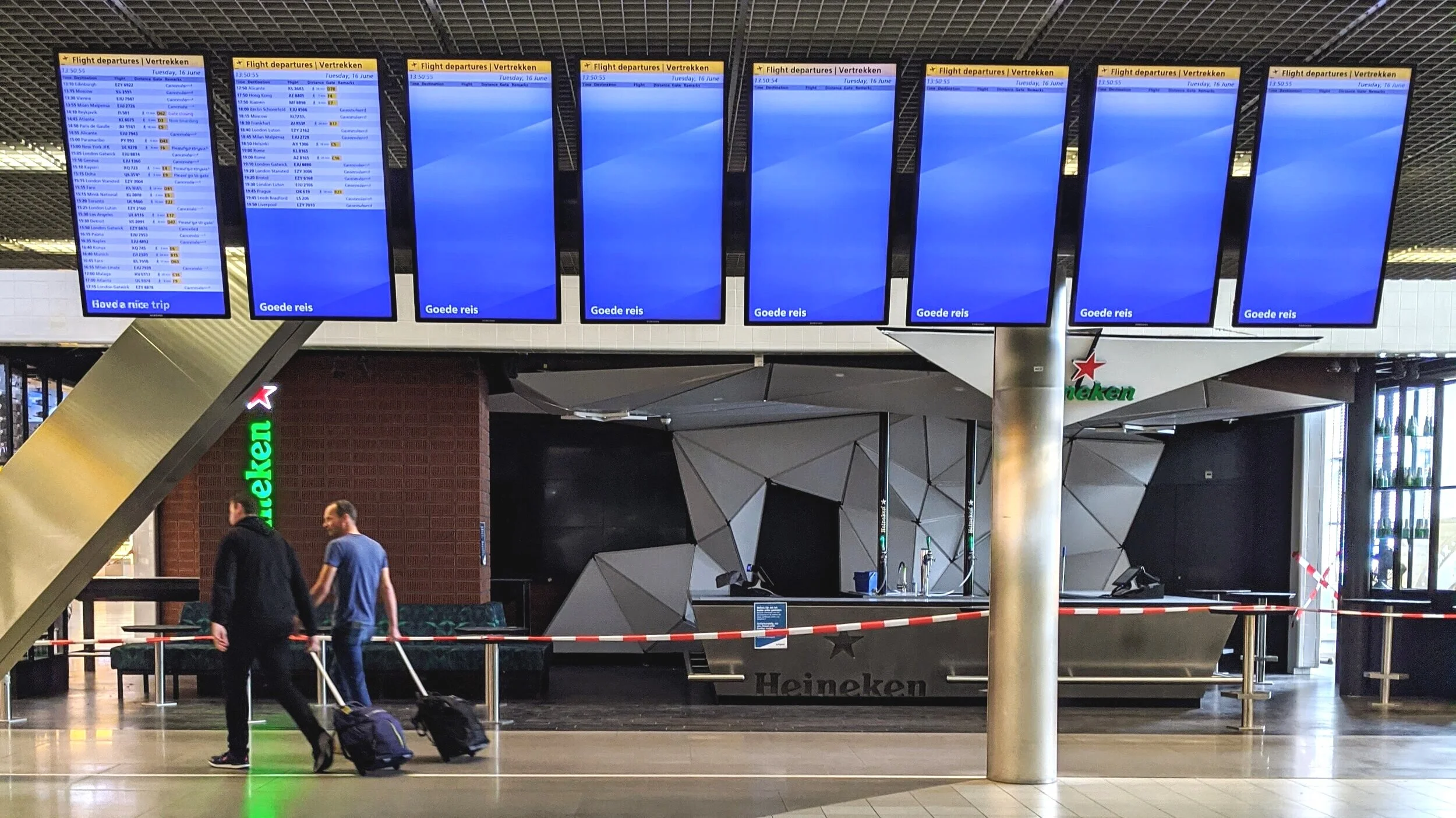
The empty flight departures reader board at Amsterdam Airport Schiphol (AMS) on Tuesday, June 16, 2020.
Editor’s note: This essay was written based on the author’s experience traveling internationally between Europe and the USA in June and July 2020. Since then, airlines have made vast improvements to the in-flight experience while keeping the safety of their passengers top-of-mind. Country entry requirements have also changed drastically since then and continue to do so as the COVID-19 pandemic continues.
Flying during a pandemic is not recommended. All non-essential travel is not recommended.
But what counts as essential?
For anyone living a global life – with friends spread around the world, in a business that depends on face-to-face contacts, or anyone who recharges from hopping on an airplane and exiting somewhere new – isolating in place for over 100 days is rough. On so many levels.
One of the joys of living abroad and being a frequent international flyer is, in 16 hours or so, I can be reunited with my closest family and friends. And pretend I’m a high-roller while becoming best friends with flight attendants as they bring drinks directly to my seat at 30,000 feet.
This year, the pandemic put a pause to our global life.
I felt a sense of panic when I flew from Dublin to Geneva via Paris during the last week of February, before the virus fully spread throughout Europe. We all thought, “Well, at least it isn’t here, yet.” Wandering through Paris-Charles De Gaulle seeing people in masks, smelling the aroma of hand sanitizer (that will eventually be calming), my heart rate increased. I tried to focus on calming breaths: it’ll all be okay, don’t panic, it’s not here, yet. And then, the world shut down.
Outbound Flight: Europe to USA
In the middle of June, after 95 days of confinement lockdown in Switzerland, I hit a wall emotionally and mentally. For lots of reasons, amplified by isolation, the depression was deep. The only way out was to go back to the US and be with family for a bit.
The CDC advises: “Staying home is the best way to protect yourself and others from COVID-19.”
But some trips are necessary. And essential.
I pulled up my favorite website and booked a roundtrip economy ticket with Delta from Geneva, Switzerland to Seattle, Washington, USA. And held my breath.
A 30+ hour journey with three plane changes and an overnight layover in Los Angeles lay ahead. All while wearing multiple N95 masks and with my good friend, a 300ml bottle of hand sanitizer.
My outbound flight from Europe to America was scheduled to depart Geneva, Switzerland (GVA) on Tuesday the 16th of June 2020 – roughly 13 weeks after most nations around the world closed their borders to anyone other than repatriating nationals. And one day after most European Union and EU member states reopened their borders.
In June, airports were still empty. Flights and routes were still minimal. And the anxiety around travel was still there, but with an odd calm on top of it. Not like the videos Americans posted with their experience repatriating to the US from Europe in mid-March.
GVA > AMS
I’m a highly anxious flyer. Even in normal circumstances and despite being three-quarters of the way to Million Miler Status with Delta, I can’t sleep the night before a long-haul and my pulse increases on the way to the airport. A friend recommends giving myself more time than I usually need. This morning, I leave my house 4 hours before the flight, haul my luggage onto the train to the airport with an N95 permanently latched to my face. US-based airlines recommend arriving 3 hours early but the bag drop for inter-European flights only opens 2 hours before. Even during a pandemic I’m early. Severely early.
Only 8 flights are departing from GVA–most of them between 10:30 am and 12 pm, then a small handful at 5 pm. That's it. It’s 9 am. Bag drop stations for most of the airlines are unmanned. I never thought the Geneva Airport could be so…big. There’s someone organizing the orange stanchions around the infinite EasyJet queue to direct one-way traffic around an escalator in the far end of the terminal. EasyJet’s not flying to GVA at this time.
There's something to celebrate about getting to the airport 3 hours early. Especially an empty airport. I haul my luggage through the orange stanchions and up the escalator to a small collection of restaurants outside of security -- McDonald's is the only one open. A friendly woman wearing a mask greets me: "Are you dining with us?"
"Oh, can I?" I say through my mask, looking past the sparse tables and see people on the terrace — I didn't even know there was an outdoor space inside the airport. "Yes, and can I sit outside?"
"Of course," she says. "Please disinfect—” pointing to the hand sanitizer dispenser, “—and here is your number. I will bring it out to you."
I do exactly as she says and sanitize again after using the touch screen to place my order.
Outside on the terrace, the air is fresh and warm. I sit down. Take off my N95 and put it in the protective plastic it came in. Mask etiquette is complicated. But there is no one around me and I am outside. Should be okay. The McDonald’s employee comes with my tray. Seeing her brings me comfort. And the best McChicken of my life.
While I eat, little birdies surround me; they don't understand social distancing.

Back off, birdie, you’re less than 1.5 meters!
I sit there until the bag check opens. About a half hour. I read. Breathe deeply. Embrace the pause in hopes of preventing anxiety.
I check my bag and head to security. It's strange to see all the staff wearing masks and sitting behind Plexiglass. My playful banter and jokes fall flatter than usual. I blame the Personal Protective Equipment (PPE).
There’s no line at security. They want me to remove things out of my pockets and a belt, if I have one. They don't care about electronics or want to check liquids.
"Just leave it all in your bag," the security agent says.
I keep my phones, passport, hand sanitizer, and headphones in my jacket pockets and I put my jacket in the bin. I read somewhere a recommendation to keep all of your personal items tucked inside your hand luggage or coat pockets instead of laying them directly on the tray as it rolls through the x-ray machine. This is to avoid your potentially exposing these items to contact with any virus lingering on the bin.
The terminal is a ghost town. The generic Swiss souvenir shop immediately on the other side of security is open. I buy some chocolate for my parents. Duty Free is open, but you walk up to a counter and tell them what you'd like. No joy in browsing. Hermes and another high-end shop are open. Oh, and a specialty chocolate shop. It’s Switzerland, after all. I buy more chocolates. My dad will appreciate them. I wonder, who and how they decide which shops to keep open and which ones to shut? But I don’t ask anyone.
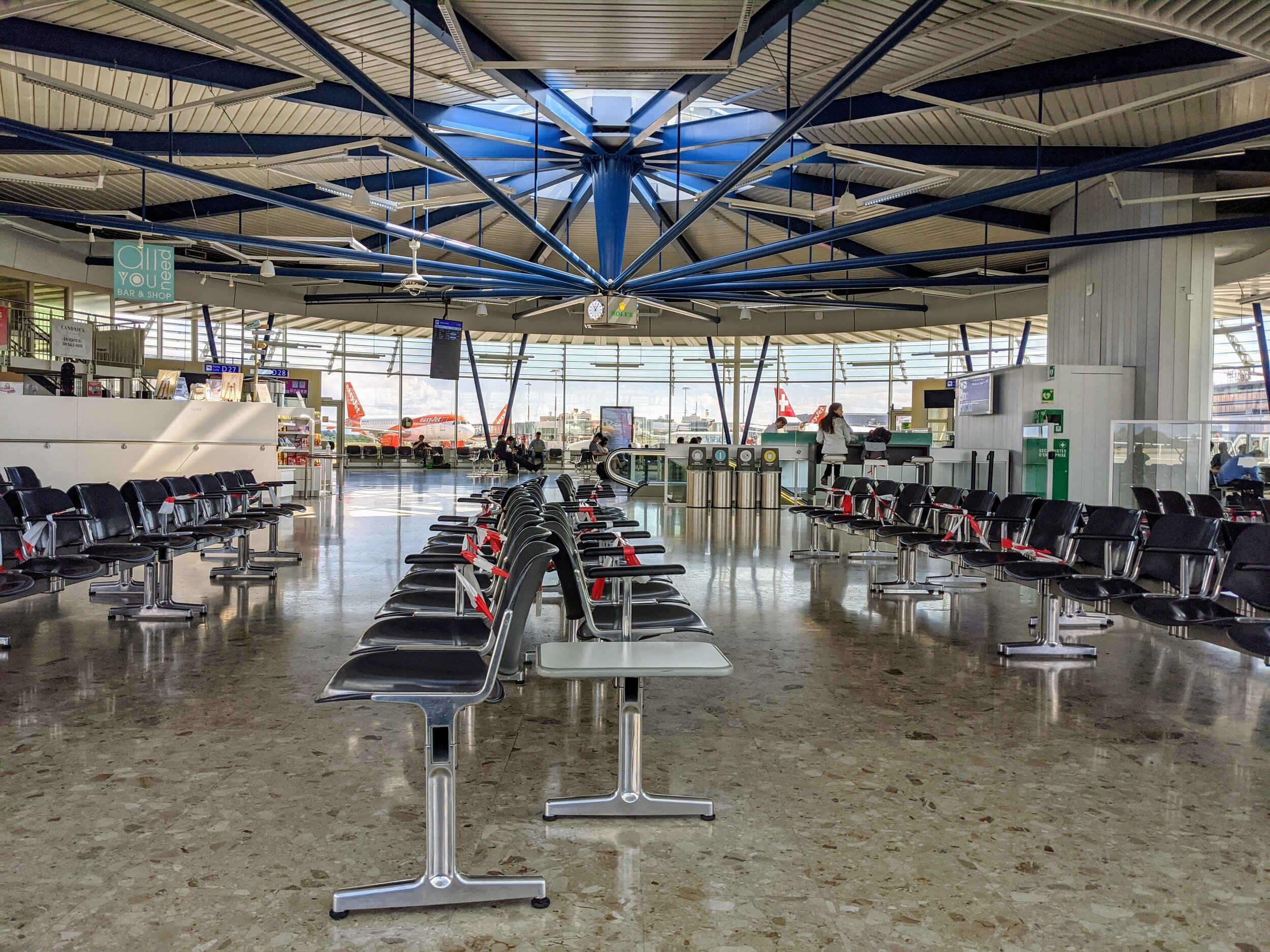
Every other seat around each gate is roped off. I wonder how families deal with traveling and not being able to sit by each other. I don’t see any families though. I take some selfies—not for the internet, but for me. I put on my glasses and learn how to breathe so they don’t fog up the lenses. I sit and practice breathing into my mask.
When it’s time, I make my way to my gate.
While on the moving walkway under the runway between the main and outer terminals, four airport police pass by. I hold my breath. They’re the only ones in the whole airport not wearing masks.
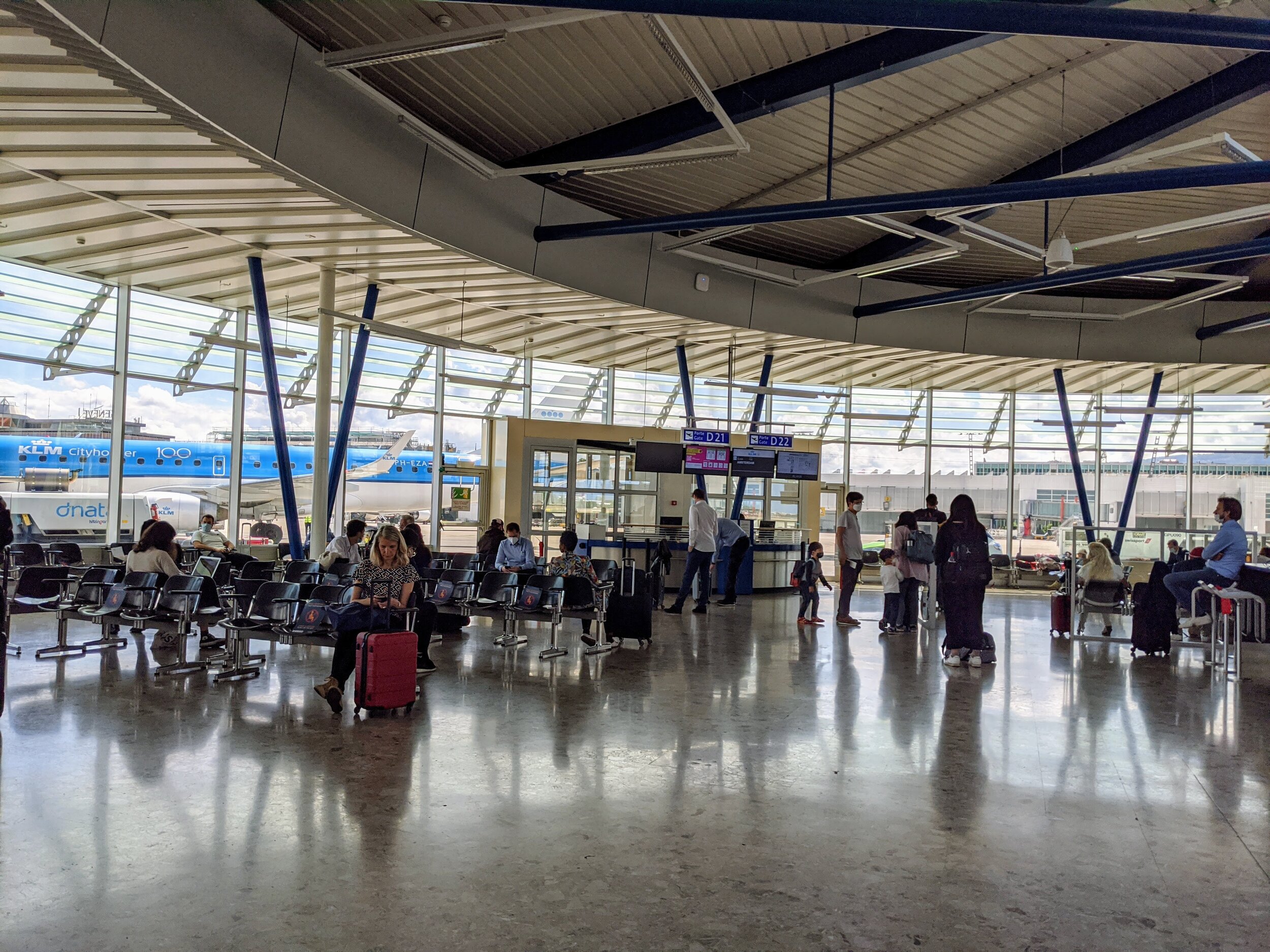
Upstairs at the gate, passengers sit in clusters. I go to the opposite end of the terminal where a 30-something man takes a business call in English on speaker. His accent is American. He is not wearing a mask. I hate him immediately and put my headphones on.
My throat is dry. I need water. The kiosk has a full bar with bottles of Campari, spirits, and beer for sale. Flights during COVID-19 don’t have alcohol on board. This goes against my usual flying rituals that start in the Sky Team lounge. I want an adult beverage, but I don't buy one. It’s 10 am, but that’s not the reason. Hand sanitizer, masks, and full-Plexi-face-coverings take up the impulse purchase real estate by the register. I expected these to be sold out inside the airport. I buy a bottle of water and stand at the back of the gate area not near anyone. I pull off my mask, drink quickly, and put my mask back on before swallowing.
KLM staff calls for boarding. Instructing all passengers to put on their masks before inviting the first section to board the aircraft. The staff asks all passengers to give extra space between each other and patience.
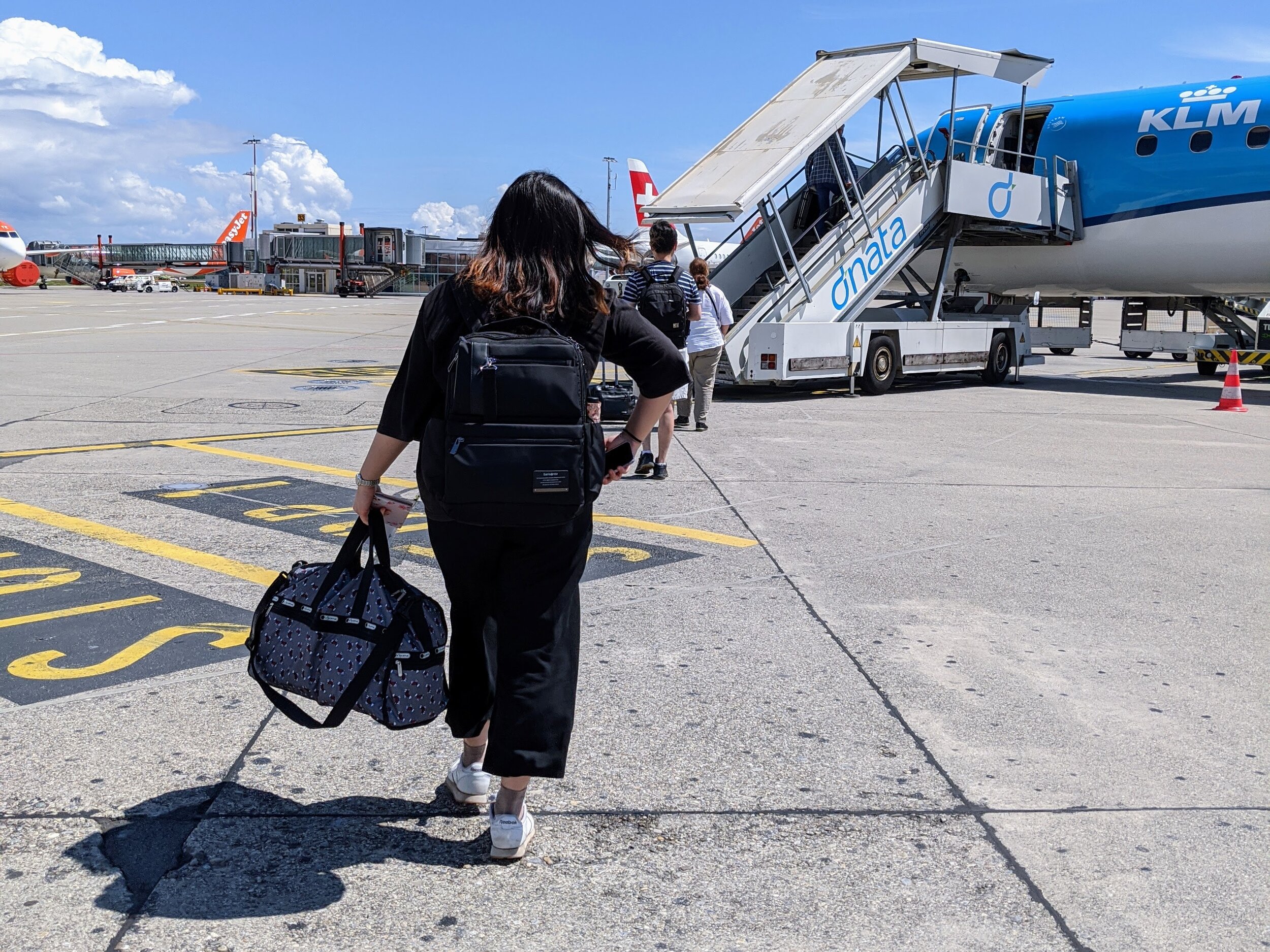
We board an Embraer 190. Everyone walks up the air-stairs in clusters up the stairs into the aircraft. Everyone is patient. It’s a new feeling. It’s…nice.
Once at my seat, I wipe everything down with an alcohol wipe. I’m the only one doing this, even though I don’t look around to be judged or congratulated. I almost forget to wipe down the seat belt buckle. (Naomi Campbell would be proud.)
A man stores his bag above my seat and sits down next to me. The Embraer has a 2-2 seat layout. I thought KLM had a policy to leave every other seat empty, but that’s okay. It will be okay. We’re both wearing masks.
After takeoff, the flight attendants deliver a boxed sandwich with a sealed Stroopwafel and water. They ask us to keep our trash and toss it as we exit the aircraft to reduce contact with the flight staff. Before deplaning in Amsterdam, I toss my rubbish in the bin – one flight down, two more and a border to go.
AMS > LAX
Amsterdam Schiphol (AMS) is empty. If it wasn’t daylight, I’d think I had just rolled off of an overnight flight from Asia, waiting for the lounge to open at 5 am. But it was close to 1 pm and broad daylight. There might be 50 other passengers connecting with me in the terminal.
Throughout the terminal are eight monitors, usually full with departing flight information. Today, only one and a half monitors are full and half of the flights have CANCELED as their status.
Passport Control between the Schengen and non-Schengen zone is usually the most chaotic place in AMS. Usually because it’s packed with obnoxious Americans who all want to cut the line to make their connection, especially if they have over 50 minutes to spare.
Today, some of the obnoxious Americans are here, but they’re on their best behavior. The line has maybe 20 people wrapping around every other stanchion to enforce social distancing. Ahead of me, is a woman wearing a backpack draped with shoes, her airline pillow, and an empty water bottle. She looks like she’s been traveling nonstop for the past few months. There’s also a family of four with two young children—one a babe-in-arms and the other able to walk on his own. Both parents are in active wear and Nikes, wearing overstuffed backpacks. These are the only young children I notice in the airport.
Border officers sit in every other booth with extra Plexi-plastic over the front so when passengers are asked to remove their masks, officers can compare passport photos and spittle won’t spread. This causes travelers’ voices to bounce off the plastic and back to the rest of us in line. I listen as an American tries to explain why his ticket doesn’t return to the US and is told to “follow me this way,” by a border officer. Border officers inside and outside of the booths aren’t wearing masks.
I walk up to the booth and hand over my passport and Swiss residency card, removing my mask when asked, and smile. The Dutch border officer stamps my passport, passes my documents back under the Plexi-plastic, and motions for me to walk on. He asks me no questions.
Relieved, I book it to the KLM Crown Lounge. I rarely get this much time – 2 hours – in the non-Schengen zone, so even if it’s closed, I’m not missing out.
The lounge is open. With fresh hand sanitizer at the door. I’m learning how to sanitize and let it dry for a moment before grabbing the handle of my roller bag. This is new travel choreography. Elbows are involved.
There are maybe 20 passengers in the lounge. Every other booth and table was roped off or vacant. I snag a prime couch near the windows overlooking the terminal. Drop my luggage to claim my space. And waltz – still wearing my mask – to the bar.
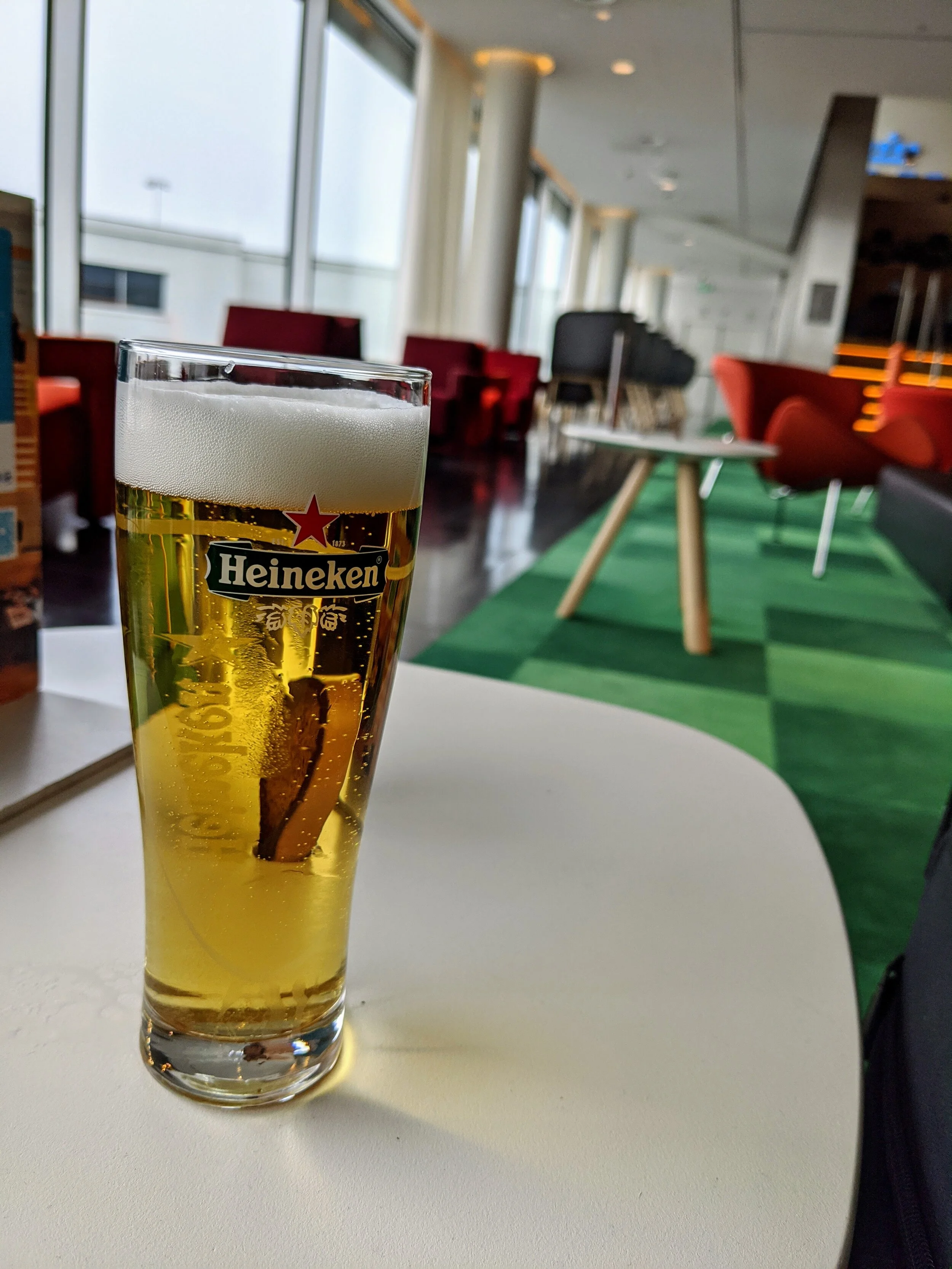
I ask the bartender for a Tinyken™, which is a glass of Heineken beer only available inside KLM Crown Lounges that you drink with pure delight and take a selfie with, posting to the internet to Matteo’s attention. Even during pandemic travels, some traditions must be honored.



I arrive at the gate as boarding starts. Fresh mask on. With my status, I can board the plane at any time. Advice from the internet says that to reduce the risk of potential exposure, it’s advisable to be one of the last to board. Especially if your seat is in front of the plane so as not to ‘breathe’ passengers as they make their way back.
This KLM flight will take us from Amsterdam (AMS) to Los Angeles (LAX) on board a Boeing 777-300er aircraft. Around 200 people are at the gate ready to board a plane with a capacity of 408 passengers. Usually when flying from Europe to America, the gate is filled with Boomers wearing Kirkland Signature jeans and a blazer surrounded by colleagues traveling together. You know the types—overly anxious travelers that rush to the front of Priority Boarding to floss their status. I prefer to sashay towards the front when Diamond Medallion is called. Today, there were no business travelers to cut in front of. Passengers were all single travelers or adult families. No young children. There was a sense of calm anxiety in the air; everyone had a reason to be flying.
I’m greeted at my seat by a 2-gallon-Ziploc bag filled with snacks. It feels like I’m on a school field trip. Inside the bag is a bottle of water, a can of Coke, a sandwich, two clementine oranges, and so much candy and sweets. In duplicate. And, of course, one package of Stroopwafels. This is all I get for the entire flight. Glad I had that Tinyken™ in the lounge.
On my seat is also a blanket. No pillows. I clean everything that I might potentially touch with an alcohol wipe and use a second one for the middle seat. Including the seat buckle, the TV screen, and window shade. When I checked the seating chart online during check-in, I had a seat buddy. But the single snack pack confirms—there will be no sharing of food or seats for me on this flight.
The seats and the floor are clean. Very clean. As in: I-have-never-seen-them-this-clean-before-in-my-life clean. As in there-is-no-way-a-child-has-ever-flown-on-this-plane. Ever. Kind of clean.


I call my mom as the cabin doors close. It’s 3:30 pm in Amsterdam and 6:30 am in Seattle.
I put my phone in airplane mode. The plane pushes back. The captain thanks us for flying with KLM during these odd times. The purser follows, with the calm and cheerful voice that I expect from the Dutch-based crew. She asks us to keep our masks on for the duration of the 11-hour flight and discourages us from lingering in the galley or around lavatory doors. And, in the rare case of a decompression, we’re reminded to remove our masks before putting the oxygen masks on our face.
I made it on the airplane that will take me to America. I am almost-almost there. I cry as we take off.
LAX > SEA
Early on in the flight, the crew delivered landing cards and health affidavits to every passenger.
Upon exiting the aircraft in LAX, we are greeted by public health workers. One for each passenger, handling about ten passengers at a time all standing about 6-feet from each other. They motion for me and the man behind me to go to the same official.
“We’re not together,” I shout from behind my mask.
“It’s okay,” the health worker shouts from behind her mask and visor.
It is not OK. I tiptoe sideways to put more distance between me and the man who was probably directly in front of me during the flight – with my filtered-breath on him the entire time.
She checks both of our questionnaires and asks us the same questions: Have you experienced any COVID-19 symptoms in the past 14 days? Do you have a fever? And so on.
Then: “You are advised to self-quarantine for 14 days upon arrival.” She hands us each a CDC flyer with symptoms and a hotline to call in case we have symptoms. “This is your ticket out of the airport; keep it with you.”
I smile throughout all this and focus on my breathing. Just in case “panic attack” is the latest symptom.
I walk through LAX’s Tom Brady International Terminal, gripping the CDC flyer for my life. LAX is—you guessed it—empty. Vacuuming starts around the empty gates below the overpass quarantining arriving international passengers from the departure gates. We might be the last international flight arriving today. It’s 5:30 pm on Tuesday. Just like Geneva. Leave it to a global pandemic to make the world’s transportation hubs adhere to ‘regular’ business hours.
At the US Customs and Border Control, the electronic landing machines are open. All I can think about is using one finger and sanitizing as soon as the receipt pops out. Every passenger is routed to talk to a Border Officer for questioning.
“Does Switzerland really make the best chocolate?” the officer asks me, looking at my documents.
This feels like a trick question. It’s been over 18 hours of quiet, anxious-ridden travel with little sleep due to feeling like I’d suffocate between my face and eye mask—what does chocolate have to do with possibly coming into the country with COVID-19?
Nothing. Absolutely nothing. Except reminding me of my favorite thing about returning to America – jokes and American sarcasm.
I collect my luggage and, with border receipt and golden CDC flyer in hand, make my way to the last checkpoint. No one asks me any questions or takes my temperature.
Outside, mask still on, I feel the Los Angeles sun on my face. Holy fuck, I made it. They let me in the country.
I make my way to an airport hotel to wait out the 8-hour overnight layover. Tomorrow morning, the third and final flight, a short, 2.5 hour connection from LAX to Seattle (SEA). Home, sweet home.


Voluntary COVID-19 Test After Arrival
The biggest fear about traveling during the Coronavirus pandemic is the potential risk of catching the virus while in-transit and bringing it home to my family. This is a risk I discussed with my family before purchasing the ticket as they could be impacted.
Five days after arriving in Seattle, I took a COVID-19 test. 24 hours later, my results came back negative and I could enjoy my time with my family without fear that I brought the virus to them from Europe. Even with a negative test, there’s always a risk of contracting the virus and developing symptoms. For the duration of my trip, I kept minimal contact with those outside of a small bubble of family and friends, plus good hygiene and mask etiquette for the duration of my trip.
Return Flight: USA to Europe
During my last two weeks in Seattle, I watch rumors unfold about Europe blocking American travelers as of July 1st. This is to allow freedom-of-movement between EU member states by preventing tourists from high-risk countries, like the US.
My heart panics. Before purchasing my outbound flight, I had conversations with my boss at work and made extra arrangements to care for my cat in Switzerland, knowing full-well that the situation could change at a moment’s notice or I might develop symptoms and be stuck.
I was not ready to end my trip early and make a mad-dash to the airport.
Body shaking, I refresh the IATA COVID-19 Travel Advisory Map and go deep on the entry requirements of every country I will transit through; cross-checking with local country sites to ensure that my documents will allow for transit and entry. Requirements such as a valid residency permit in the country I am returning to, Switzerland, and health declarations.
Checking and re-checking these sites and news sources – what’s official and what’s speculation? Fielding texts from friends worried that I didn’t see the news. Do I change my return flights or not? Processing the fact that I will have to say goodbye to my family and friends – too soon. The support system that I severely missed during confinement – we all did – and their grounding power that helped heal my mental health. I am not ready to say goodbye. Not yet.
SEA > DTW
The best part about wearing a mask is, if you’re an ugly crier, no one can see your face. And the trick to pretending like nothing is wrong is to squint your eyes and perk the sides of your mouth up. This will give the illusion that you’re smiling. While on the inside of your mask – and your heart – you are a mess.
My parents drop me off at the curb at 5-in-the-morning. I hug them tightly. Tears flowing. Not knowing when I’ll see them again. Not wanting to let go. But knowing I have to put my mask on and walk myself into the terminal and try and return to Europe.
The wonderful woman at the Delta check-in counter doesn’t notice my tears. She takes my US passport and Swiss residency card, scanning both into the system. My get-out-of-America cards. She sings about how she enjoys working during the pandemic, sharing stories about the diversity of customers who chose to fly during this time. A lot of them, it’s their very first time flying. But doesn’t go into detail beyond that.
It’s Sunday the 12th of July. It’s a minimum 22-hour journey departing Seattle-Tacoma International Airport (SEA) at 8 am and connecting via Detroit (DTW) to Amsterdam (AMS) then Amsterdam to Geneva (GVA). Three long flights again.
The TSA security line is long, but not outrageous. Everyone is wearing a mask. I do my best to toss death stares through my tears at those with noses poking out. No TSA pre-check or Priority Access line. We are all the same walking through this.

Going through security at TSA Checkpoint inside Seattle-Tacoma International Airport
Inside the terminal, things look a little different than a month ago. The reader board is full, but not too-full. There are people in the terminal but not as many as there would have been on a Sunday morning during summer peak travel season.
Boarding the plane in SEA to DTW, the gate agent scans my Swiss residency card again. Even though the first leg is a domestic flight, they will not let me on the plane unless I have proof that I can complete the journey.
I snag a first class upgrade. On the plane, the masked flight attendant hands me an alcohol wipe. By this time, I’m a professional. Once in the air, he presents me with a tray of beer in cans and plastic cups.
“Oh, this is new,” I perk up from behind a fresh N95 mask.
“When did you last fly?” he asks.
“About three weeks ago.”
“At this point, that’s an eternity,” he says. Accurate.
We speak about the pandemic and canceled vacation plans to Europe. He had a holiday coming up and planned to spend three weeks in Italy. I was supposed to spend two weeks in Portugal with my best friend, an American who lives in the US and only has a US Passport.
We talk about how President Trump doesn’t believe the pandemic exists and how irresponsible our fellow Americans are in ‘other parts’ of the US. Florida records 15,000 new cases that day, its highest-number of new cases to date.
DTW > AMS

The world has been waiting for you. So has Delta.
To board the flight from DTW to AMS, the Delta staff ask all passengers to complete a health questionnaire as required by the Dutch authorities. If we don’t already have this form with us, there are extras at the check-in desk at the gate.
While waiting to board, I check out my fellow passengers hovering around the gate in a socially-distanced way. Two Asian men in their 20s who look like college kids. I can’t make out which country their passports are from. Are they heading back to Europe after studying abroad from their dorm rooms all year? Or are they simply traveling in the US prior to Stay at Home orders and decided to go home? A short man with superior muscles and tattooed arm sleeves – I assume a military contractor on his way to Germany. I try to eavesdrop on a pair of 50-something men speaking a different language, but can’t make out the origin. Again, no children at the gate or anywhere in the terminal.
Onboard, more supplied alcohol wipes, more thanking us for flying during these challenging times.
I get an entire row to myself again, but no business class upgrade. The familiar drink trolley comes down the aisles. Hello, old friend. We are given a choice of two meals for dinner service. And a secondary drink service. It’s almost as if we were flying during normal times. The flight attendant refills my wine glass. Twice.
I am an expert at sleeping on a plane during a pandemic – sleep on my side with my knees tucked in to avoid the beverage cart; use my hood to cover my eyes, instead of an eye mask; and remove one ear loop off the face mask, holding the loop with my hand under my head to keep my mouth covered. This avoids the feeling of suffocation caused by wearing an eye mask and a face mask. 8-hours pass quickly. But lack of sleep the night before, wine, and an aching heart helps with that.
AMS

It’s always nice when you watch your own luggage roll into the belly of the airplane.
Landing in Amsterdam at 8 am the following day is disorienting. AMS is busier. Masks are still compulsory, but every single person wearing an official Schiphol staff uniform is not wearing one at all. Including terminal personnel, construction workers, and border officers. It’s weird.
With just over 2 hours before my final flight, I head straight to passport control with my health declaration, passport, and residency card clutched in my hands; fearful that I’ll lose one of them and be stuck in non-Schengen purgatory. Or worse—have to get back on an airplane to America.
The line between the non-Schengen zone and Schengen zone is long. Perhaps 100-feet into the main terminal. I can’t see the beginning to know if I’m in the correct line or not.
It’s okay. Deep breath. Plenty of time.
The line moves fast. Every other stanchion is skipped again in an attempt to dictate social distancing. But the 20-something man behind me has his nose peeking out of his mask is absolutely closer than 3 feet (or 1.5 meters). I put men-who-don’t-tuck-their-noses on the list of travelers I hate. He’s in good company with the Kirkland-Signature-jean-wearing business travelers. But I might trade him for the business traveler right now.
I reach the front of the line and hear a woman with an American accent arguing with border officers. She has a manila envelope thick with papers. Is she trying to negotiate her way through?
It’s my turn. I walk up to the beautiful, tall, tan Dutch border officer on the other side of the extra plastic barrier. I hand him my documents. He motions for me to remove my mask. I do so and smile brightly. He stamps my passport and passes my papers back through the opening beneath the window and stares at me. I smile through my re-attached mask. He motions for me to move on. He asks me no questions. He does not take my health questionnaire.

AMS is a little busier in July than it was in June…
AMS > GVA
On the final flight from AMS to Geneva, KLM staff pass out a new health questionnaire to every passenger as required by Swiss law. It’s similar to the one required by the Dutch authorities and includes more details about our individual flight path including any connection and detailed contact information in the unlikely case of someone on the plane testing positive for COVID-19 after this flight.
As of July 6th, the Swiss government announced mandatory quarantine for persons arriving in Switzerland from high-risk countries. The list of high-risk states are updated every two weeks based on the number of new cases of COVID-19 that are reported based on the population. The US is included in the list.
I hand my health declaration form to the Swiss official waiting on the jetway as I leave the plane. I collect my luggage and head straight to my home in Lausanne, Switzerland and stay there for 10 days. I experience no flu-like symptoms.
When will I hug you again?
When my parents dropped me on the curb at Seattle-Tacoma International Airport, I hugged them tightly. Tears flowed. Not knowing when I’ll see them again.
Before the pandemic, we could hop on an airplane for a short or long weekend and exit the fuselage and end up on the other side of the world. It was easy to maintain friendships and lovers in other parts of the world and with passports that were different from our own. Zoom was a verb, not a formal noun. It was a privilege we took for granted as we racked up the air miles and marched towards Million Miler Status.
The pandemic changed this. For me, it made me acutely aware of how not-physically-close I am to those that I love. Yet at the same time, emotionally connected because we are all in this together. Even if we are further apart than ever. When in our lifetime has everyone in the world shared such a similar experience?
Be it good or bad, it’s something.
This year, the pandemic put an end to the ease of the global life we led before.
And, hopefully, it’s only a pause. And we will emerge from it differently somehow. Somehow more connected. Somehow more thankful for the moments and the miles that connect us, not keep us apart.

Sea-Tac, you so punny

No raclettes: Swiss Lounge at Zurich Airport - Review
In her first post on Tech Travel Geeks Alana reviews the Swiss Senator Lounge at Zurich Airport.
Hello lovely readers! After drinking with Matteo and Lukasz on many continents, and leading Matteo to some of the weird and wonderful highlights Shenzhen has to offer, it’s a pleasure to be writing for this fine publication myself (we’ll show you Eurovision street and the world’s best custard tarts next time, promise!).
I had the pleasure of spending this weekend in sunny Switzerland. Weekends away mean flights which means…lounge visits! Over the weekend I’d already eaten my body weight in fine chocolate and awesome cheese, but everything in moderation, including moderation, right?!
First things first, to find the place. I visited the Senator Lounge, just around to the right after security, towards the A gates. It was very easy to find, and a quick scan of my boarding pass and I was in.
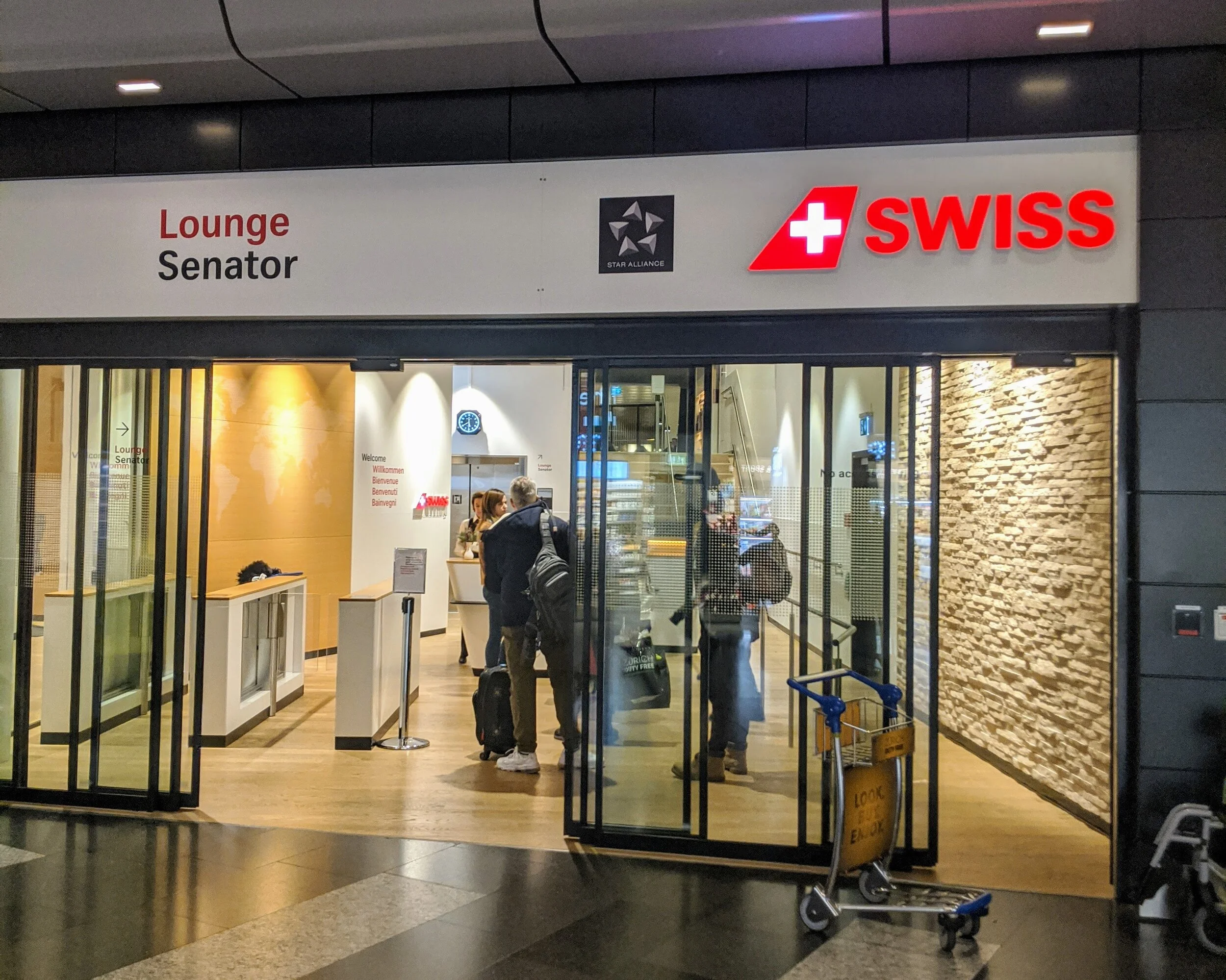
Past security, turn right, voila!
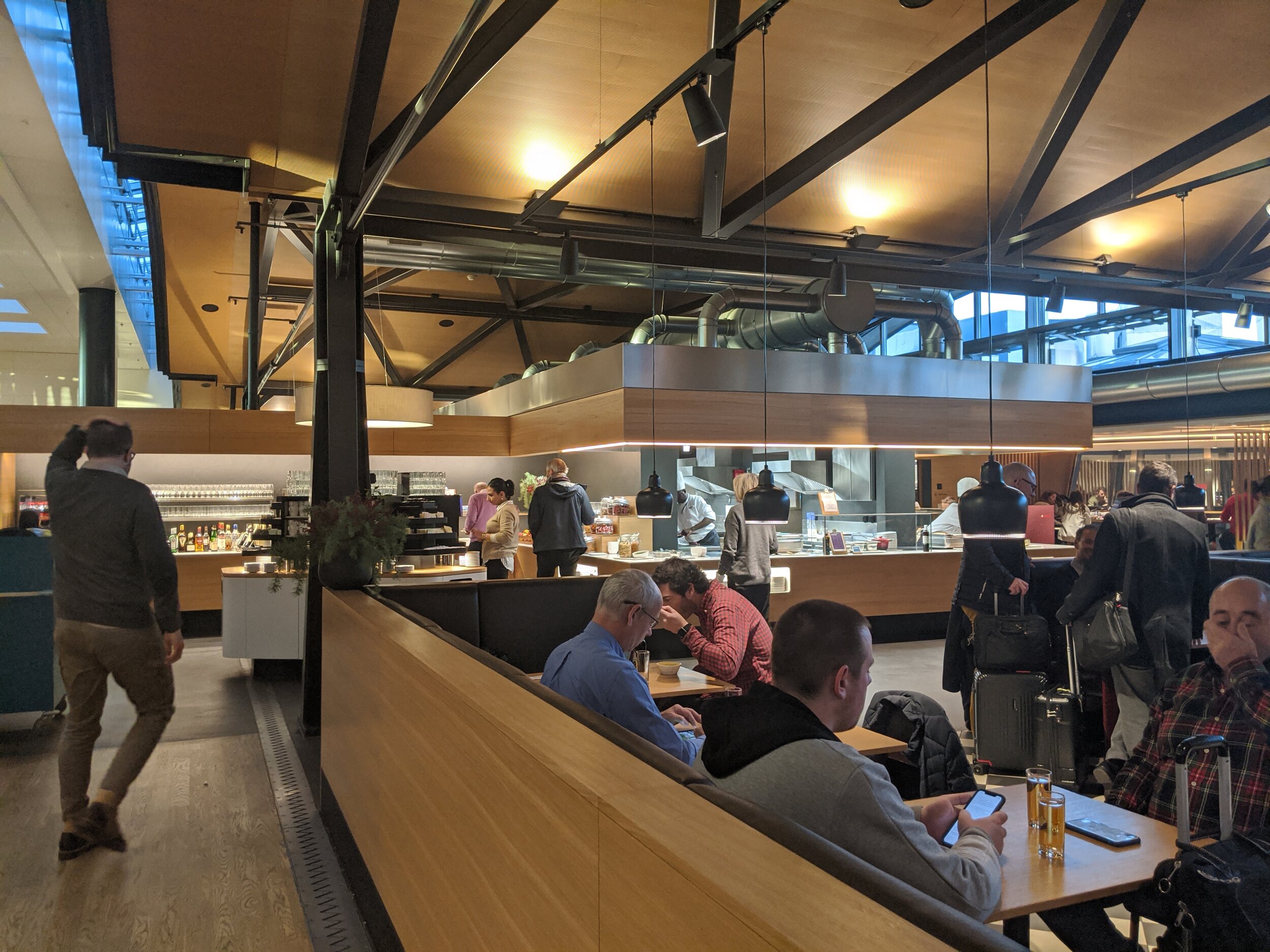
First impressions were: the space was lovely, bright and airy, but man was it BUSY! I walked around for at least 5 minutes, feeling like I’d arrived late to the party and everyone else had settled in, made friends, swapped life stories and there were no free seats.
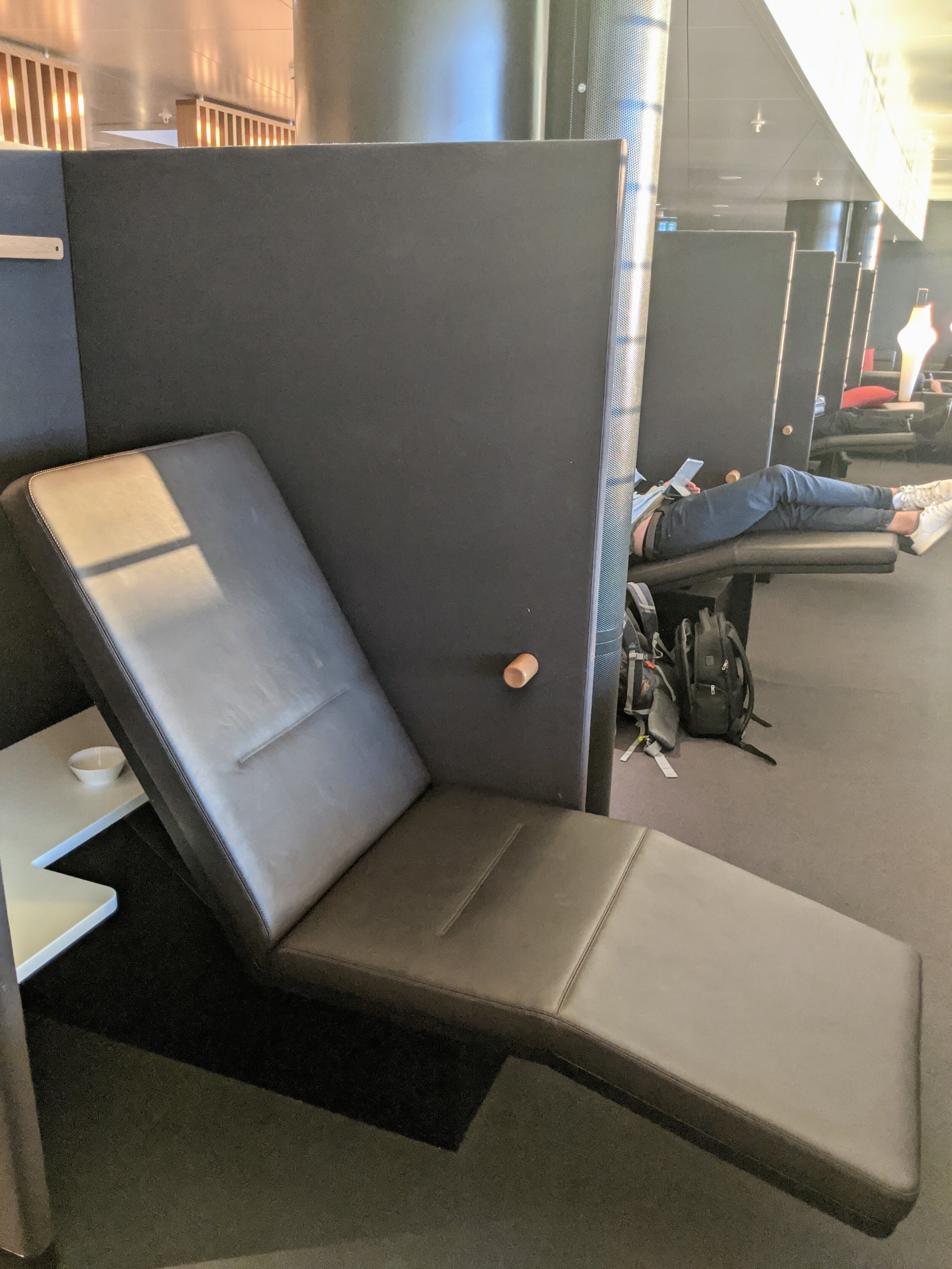
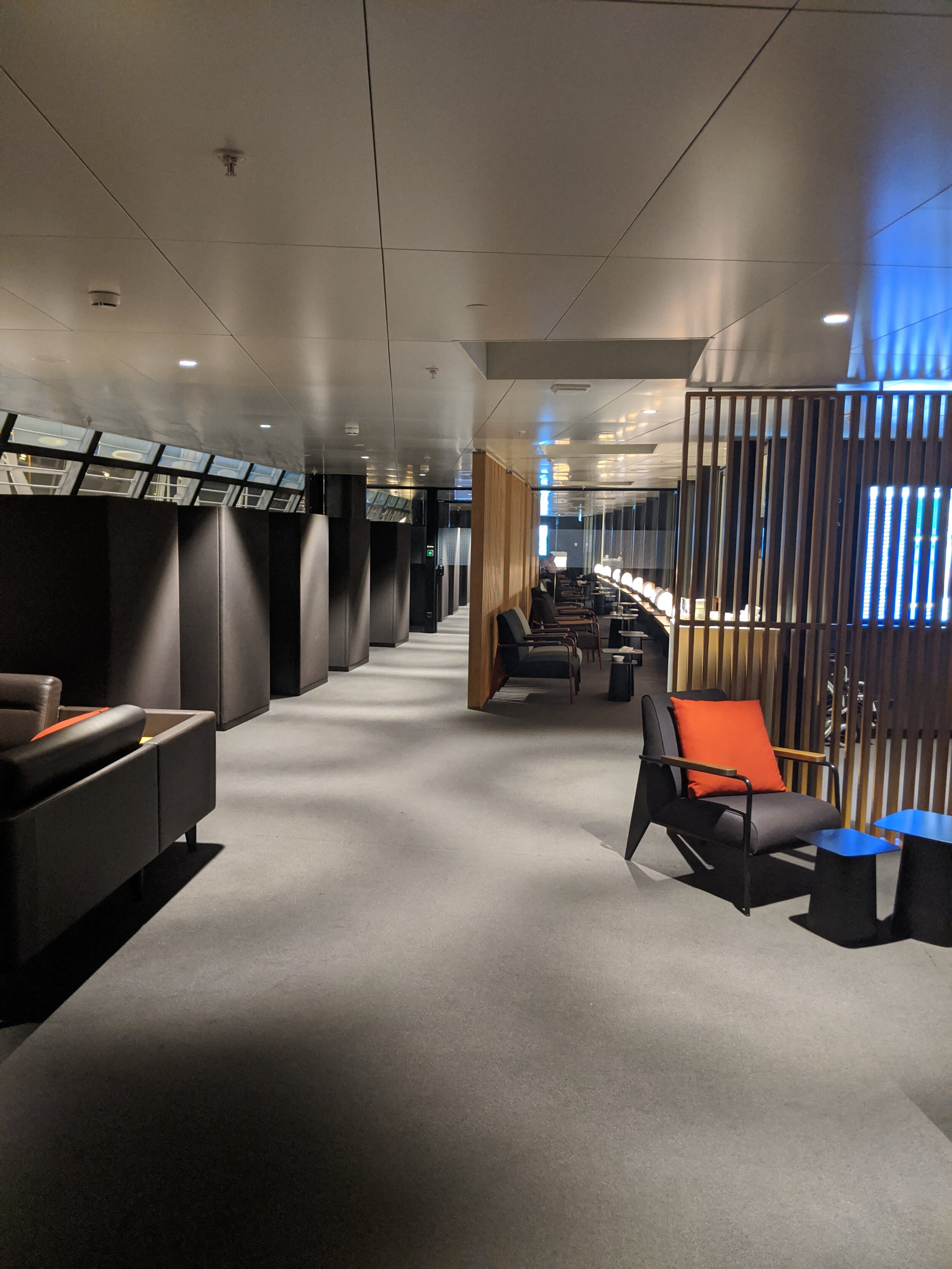
After 4 or 5 awkward laps trying not to clothesline any small children with my bulky winter gear, I found a spot in the quiet zone upstairs. I think everyone was avoiding it because of the no-food rule, but the stacks of plates spoke to a slightly more lenient approach.

No room at the inn

My own quiet, cosy corner
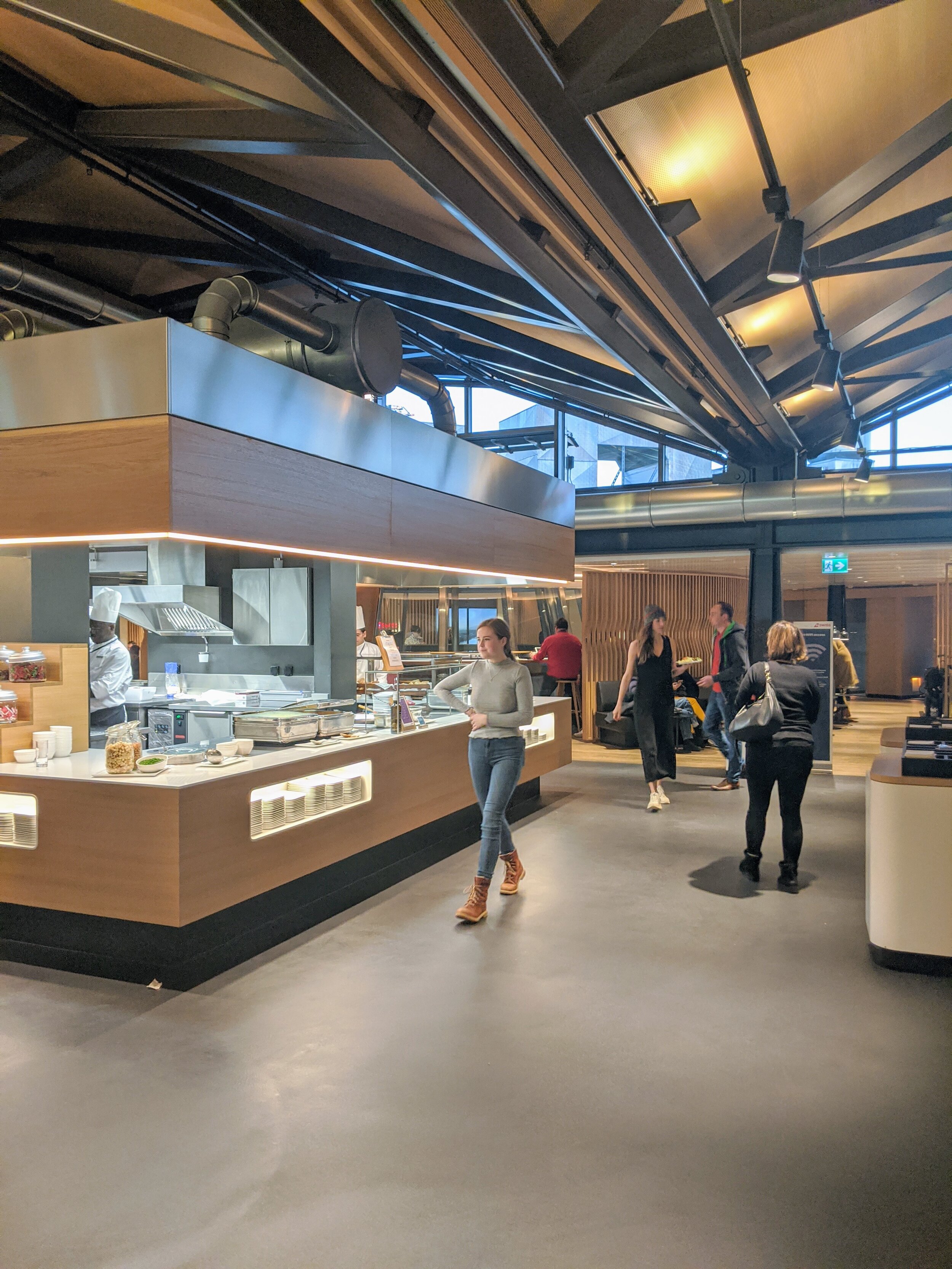
The feeding and watering options were great - a large selection of both alcoholic and non-alcoholic drinks, a coffee machine with more buttons than a spaceship, racks of fruit, sweets, bread, cheese, cheese and more cheese (it is Switzerland, after all), and best of all, a team of chefs preparing hot food to order. The dishes weren’t anything amazing, but the setup was really nice and you got the feeling the food was fresher than you might find in an airline lounge.


So, with shelter, food and water procured, my attention turned to the next item in Maslow’s adapted-for-Tech-Travel-Geeks hierarchy of needs: internet. There were signs around for Wi-Fi access, with the spectacularly unhelpful instruction to ‘go to the Wi-Fi printer’. Can one print Wi-Fi? Were the Swiss really so far ahead?!.
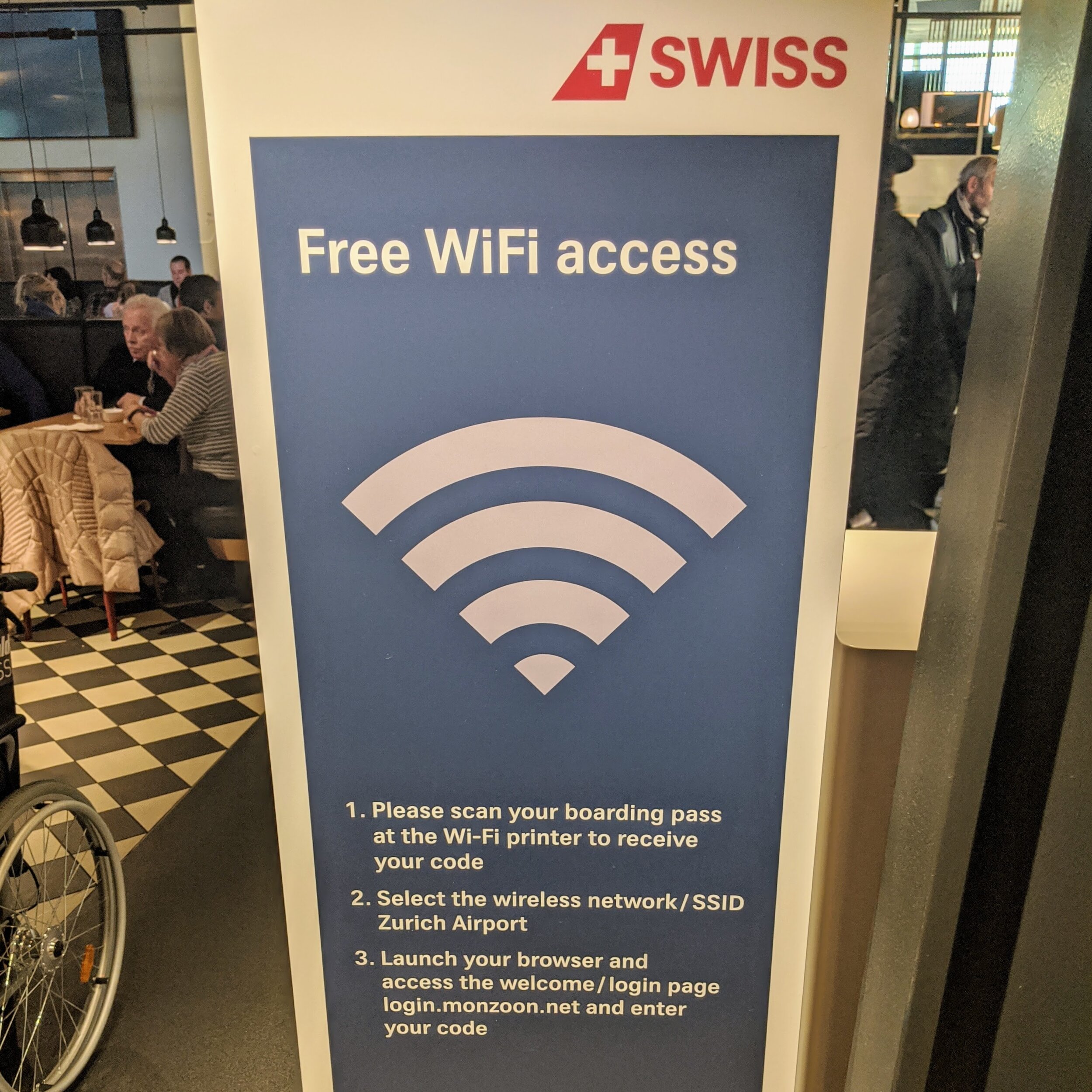
Not helpful, Swissair.
There was a printer at the back of the lounge, but it didn’t look aware of the internet in any form. Decoy, or sneak 500? I decided on decoy, and utilised the survival tools at my disposal. I asked a member of staff, who smiled and pointed me towards an unlabelled, unassuming white cube by the entrance stairs.

Yes, the one that looks like a bin.
So, with a seat, drinks, food and a connection to the outside world, I could finally settle in to wait for my flight. But wait! There’s one more need to satisfy…
Ahhh. All the charging points a Tech Travel Geek could need, and right in the comfort of my own chair.

2 USB ports, and plug sockets to suit every taste and budget.
Overall, the lounge is very pleasant. Great food and drink options, a lovely open modern feel and ample connectivity. There are also showers, private ‘cabins’ at the back for calls, plus a smoking area if that’s your thing. The only downsides were the lack of seating (although the crowd had thinned out by the time I left) and the confusing Wi-Fi setup, but all in all, a nice place to relax before a flight.

The Tech Travel Geeks are at IFA 2019 in Berlin!
The Tech Travel Geeks are at IFA in Berlin. Would you like to get in touch? Here is how.
The Tech Travel Geeks are covering IFA 2019 in Berlin this year.
The IFA or Internationale Funkausstellung Berlin (International radio exhibition Berlin, a.k.a. 'Berlin Radio Show') is one of the oldest industrial exhibitions in Germany. Between 1924 and 1939 it was an annual event, but from 1950 it was held every other year until 2005. Since then it has become an annual event again, held in September. Today it is one of world's leading trade shows for consumer electronics and home appliances.
If you too are at IFA and would like to meet up, or would like to have a request for Tech Travel Geeks’ coverage, please get in touch using our form or tweeting at us.
Expect plenty of content here on the website and on the Tech Travel Geeks YouTube channel.
We are grateful to Huawei for hosting us this year and the Berlin Messe for recognising the Tech Travel Geeks as Media for the trade show.
Follow our reports from IFA 2019 on our Youtube channel:

Microsoft Surface Book 2 Review - Best Travel 2-in-1 Laptop?
Lukasz Suliga, Chief Aperture Officer at TechTravelGeeks, reviews the Microsoft Surface Book 2: a 13.5" multi form factor laptop.
Hi there, it's Lukasz for Tech Travel Geeks. I'm currently on a 6-week-long round-the-world trip, and I wanted to share my experience with the Microsoft Surface Book 2, the latest flagship laptop from Seattle released in the UK in November 2017.
Let's go through some of the key features of this laptop, touching on other available models as well.
Screen
Microsoft Surface Book 2 laptop
There are two main versions of this laptop - one with a 13.5" screen, and the other with a bigger, 15" monitor. Both are top-of-the-class panels, with 3k 3:2 resolution (3000 x 2000 or 3240 x 2160 pixels), very bright screens, great colour reproduction and viewing angles. I have the smaller version of the laptop and I've had no problems using it in the bright daylight in Fiji and Australia, so I'm sure it will be good enough for any location.
The screen, as is common nowadays with most flagship laptops, is touch-sensitive. I've found it to be very responsive and easy to use when needed. In addition to that, as with other Surface products, it supports the Surface Pen, which is fantastic for anyone who uses it as a creative tool. Unfortunately, unlike the previous model, this one doesn't come with the pen included, so it's required to purchase it separately. Since I don't do much drawing or handwriting, I haven't purchased it yet, but based on reviews online, it looks like a good product.
Build
Surface Book 2 build quality is fantastic
The main selling point of the Surface Book 2 (and its predecessor) is the fact that the screen is detachable. In order to detach it, you have to press a button on the keyboard (the laptop has to be switched on for that though), and it removes very easily. The screen is connected to the rest of the device by a very interesting hinge, which has so far been great - after almost 6 months of use, it's very stable and convenient to use. The screen can go back to around 135 degrees, so it can't go flat, but you can turn the screen around and use it flat, or detach it completely and treat it as a large and powerful tablet.
What's very interesting is how the components are distributed. Everything that's needed for it to function is in the screen, including the hard drive, processor, built-in graphics card and all the other components. The keyboard part, on the other hand, has an additional battery and a dedicated Nvidia graphics card, so for more taxing purposes it's better to use it in the laptop mode, but for anything else, using just the screen is perfectly fine.
Furthermore, the build quality of the laptop is fantastic. The silver metallic look is great, with the hinge making it a very unique and easily-recognizeable laptop. The single Windows logo on the top adds to the premium look. The keyboard is very responsive and a pleasure to type on, I believe it's one of the most convenient ones available. The touchpad has been very good as well, allowing me to edit some videos without any problems. And it all easily fits into my bag, which has been fantastic for travels.
Performance and battery life

Surface Book 2 performance is great, including modern games like Fortnite
When it comes to performance, the laptop supports a number of CPU variants. It starts with the Dual Core M5 processor with an Intel HD Graphics 620 integrated graphics card, but it's quite low-end, so I wouldn't recommend it for content creation. There are also Intel Core i7 models available with the 8th generation Kaby Lake R processors. I picked the i7-8650U CPU clocked at 1.9GHz version to ensure the best performance, but the i5 should be good enough for most casual uses like browsing the internet or some basic gaming. It also comes with a few memory options, up to 16GB, and up to 1TB hard drive.
When it comes to graphics cards, this is where it differs between the 15" and 13.5" versions of the laptop. The bigger laptop supports a higher-end graphics card - Nvidia Geforce GTX 1060 with 6GB of video memory, compared to GTX 1050 with 2GB of memory on the smaller model. However, Geforce 1050 is still one os the most powerful mobile graphics cards available, allowing you to play most games on medium to high settings, including popular games like Fortnite.
I personally don't play too many games, and my main focus is on content creation. It's here where the Surface Book 2 delivers - it's even capable of editing 4k video in Premiere Pro. This has been a key consideration for my purchase, and I have to say I'm very happy with it. I have so far edited a number of videos on this laptop, including the "What's in my bag" video and the one you're watching just now for this channel, as well as a "Shark Tale" video from Fiji on my personal channel, so feel free to check them out. This laptop has now replaced my older desktop with an Nvidia 1060 graphics card, and I've never looked back.
When talking about performance, I can't forget about the fantastic battery life. As mentioned earlier, there are two batteries included - one in the screen part, and the other in the keyboard part. The former, on its own, can last a few hours, so it's not that amazing, but when attached to the keyboard, the laptop is one of the best ones available, allowing you to use it without charge for a full day. This comes in handy especially during holidays, when you want to take it with you or just don't have an outlet around.
Connectivity and cameras
Surface Book 2 cameras are actually great quality for a laptop
The laptop includes a number of very useful ports. The key one for me is full-size SD card reader, since I spend a lot of time downloading footage from my main camera. It also has two full-size USB 3.0 ports on the left, as well as a USB-C port on the right. The latter, however, is where one of my few issues with this laptop lies - it doesn't support Thunderbolt 3, so it's not possible to connect a separate dedicated graphics card to it, connect more than one 4k monitor or use other Thunderbolt accessories. And while it supports powering the laptop through this port, it's really slow and it will barely maintain the current battery status instead of actually charging it. Still, it's good that it's included in the first place.
For charging, instead, you should use the proprietary charging port. On the plus side, it's reversible and magnetic, similarly to what's found in MacBooks, so I've been very happy with it. And there's an extra bonus as well - two additional USB outs in the power brick itself, which allow me to charge my phone and camera without the need to bring additional USB chargers - small thing, but makes a big difference while travelling.
On the screen part, you will find the power button and the volume rocker at the top and the headphone jack on the side. At the front of the screen, there's a front-facing camera, which takes photos of up to 5 megapixels and records video in FullHD. The front facing camera is actually great and really clear, amazing for video calls with family while you're away, so it definitely deserves props for it. It's best feature, however, is that it supports Windows Hello, which is a very quick way to unlock your screen with the camera, using facial recognition and near-infrared imaging. I have to say I love it, it's very fast and just works every time, I can't praise it enough. There's also an 8MP back-facing camera which also records FullHD video, but let's be honest, who's going to use it as a camera?
Conclusion
Surface Book 2 is a great, yet quite expensive, 2-in-1 laptop
So, is the Surface Book 2 worth it? As a premium device from Microsoft, it comes with great build quality and top specs, and has deservedly been called the best 2-in-1 laptop available by many reviews. However, it comes at a premium price. It's definitely not cheap, starting at £1500 for the dual-core version, and going to £3149 for the top-specked model. The model reviewed was 13.5" with Core i7-8650U CPU, 16GB of RAM, an Nvidia GeForce GTX 1050 GPU with 2GB of VRAM and a 500GB SSD, priced at £2499. You will be able to get cheaper setups from Dell or HP, but you'll sacrifice either build quality or access to top specs.
What this laptop is meant to do is to compete with Apple and give an alternative to Macbook Pro. If you prefer to use Windows software or aren't a big fan of the closed system of Apple, then this is a fantastic alternative. I personally grew up with Microsoft software, starting with DOS and Windows 95, so using Windows 10 is second nature for me. If you're a fan of Apple, well, I guess you've made your choice.
To sum up, having been using this for almost 6 months, and being 4 weeks into a round-the-world trip, I couldn't be happier with my purchase. If you want one of the best laptops on the market, with great specs, fantastic battery life, excellent screen, build quality and a unique approach to 2-in-1, and you don't mind spending a bit more to get the best that's available, go for it!
Thanks for watching Tech Travel Geeks. If you enjoyed this video, please give us a like and consider subscribing to see more videos like this. Cheers!